Skjold. I went to see an exhibition, and almost ended up on a football pitch
16. November 2026
Anežka Ondračková
A conversation overheard at an exhibition opening leads Anežka Ondračková to Copenhagen’s Østerbro Stadium, into changing rooms 2 and 3 of the football club Boldklubben Skjold. There, Skjold Contemporary presents the group show “FODBOLDENS VOKABOLARIUM #2”, featuring 22 works by 22 artists at the intersection of art and football. Between wooden benches, showers, and dripping water, she asks how much a place shapes what we see, and looks at works by Alida Lama and Mette Kit Jenses.
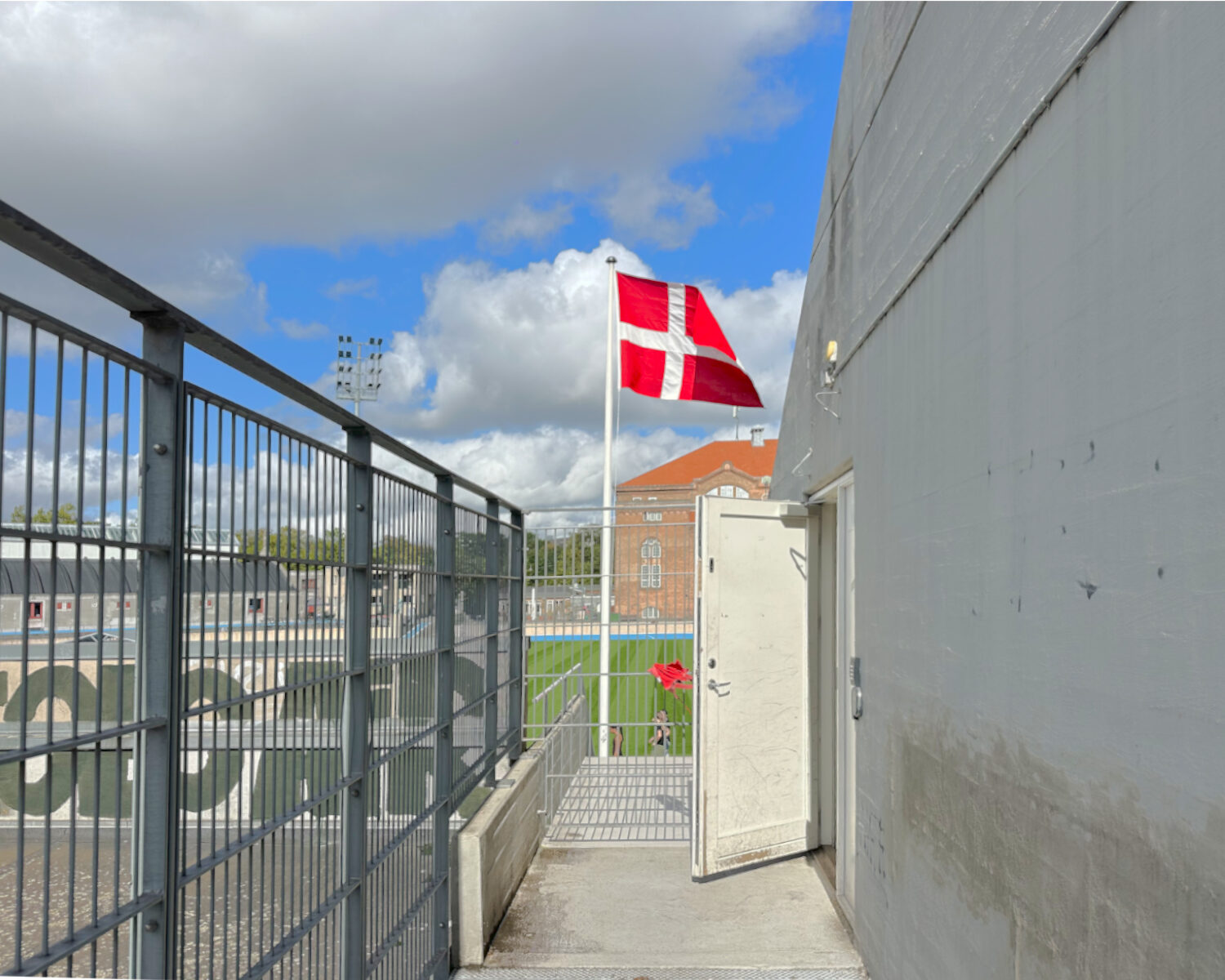
How did I end up in the changing rooms 2 and 3, where this exhibition is held? It was thanks to eavesdropping during a different exhibition opening I attended. Due to my lack of social interaction, I was strolling around and catching pieces of people’s conversations. “If you like this sort of off-space exhibition [that one was in a cold war bunker], you should go see Skjold Contemporary. Not many people know about it.” I definitely didn’t. Of course I didn’t have the courage to approach them and ask, so instead I dived into the depths of the internet, where I luckily found the answers I was looking for.
Skjold Contemporary is an “art gallery” and initiative run by Boldklubben Skjold, and is physically based in changing rooms at the Østerbro Stadium, Per Henrik Lings Allé 10, Copenhagen. Besides running various exhibitions, Skjold Contemporary also organises events and other programmes. Overall, the gallery is working towards bridging the gap between contemporary art and football.
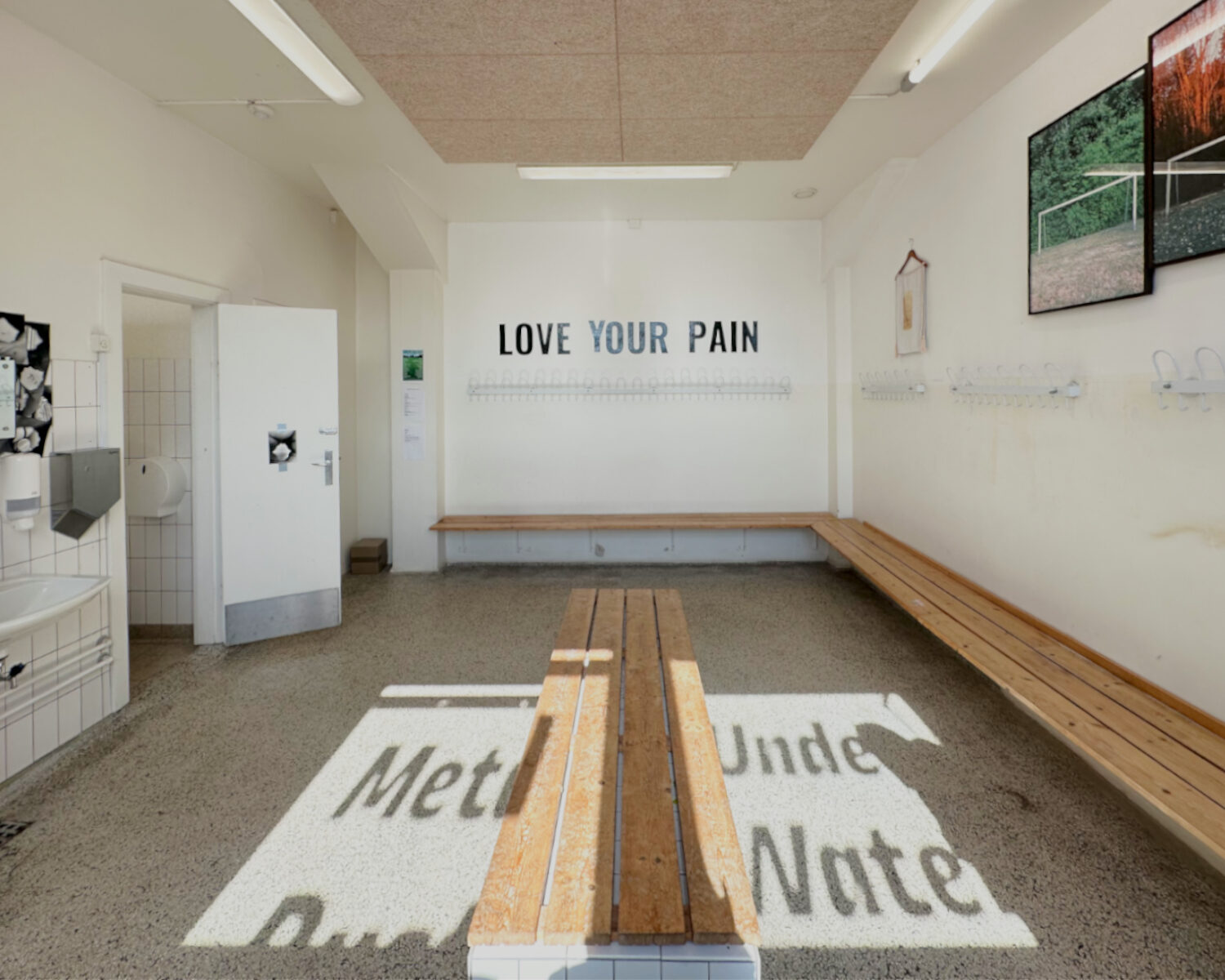
The exhibition currently on show is titled FODBOLDENS VOKABOLARIUM #2 and is a group show of 22 artists, each being featured with one artwork, until November 1st, 2026. As the title suggests, it is the second one in the series of FODBOLDENS VOKABOLARIUM. The works shown are the physical bridgings between the worlds of football and art. Sure, these may seem like two completely different worlds: the art sector being marketed as a high, even elitist field, while football culture bears a completely different connotation, even though probably with much higher success at least in terms of popularity with the general public. I suppose not many people who regularly come to galleries would find themselves watching a football match and vice versa. So for a little moment, put the prejudices about art/football aside and try to enjoy what I witnessed in these changing rooms.
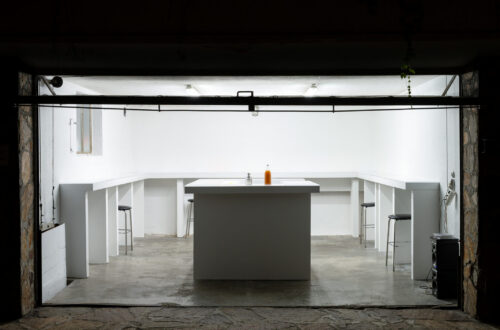
The first impression upon entering the changing room 3 was … damn, what is this sound? It sounded as if water was dripping and so I looked around the room to find an artwork that has – supposedly – an audio recording to it. After my brain woke up and didn’t find any speakers, I saw the shower room with no doors accessible straight from the changing room. I peeked in there and saw the “audio installation”. Water leaking from one of the shower heads. I mean, I suppose my head still hasn’t gotten over the fact that this is not another one of those white walls, no windows, no context, white cube gallery spaces.
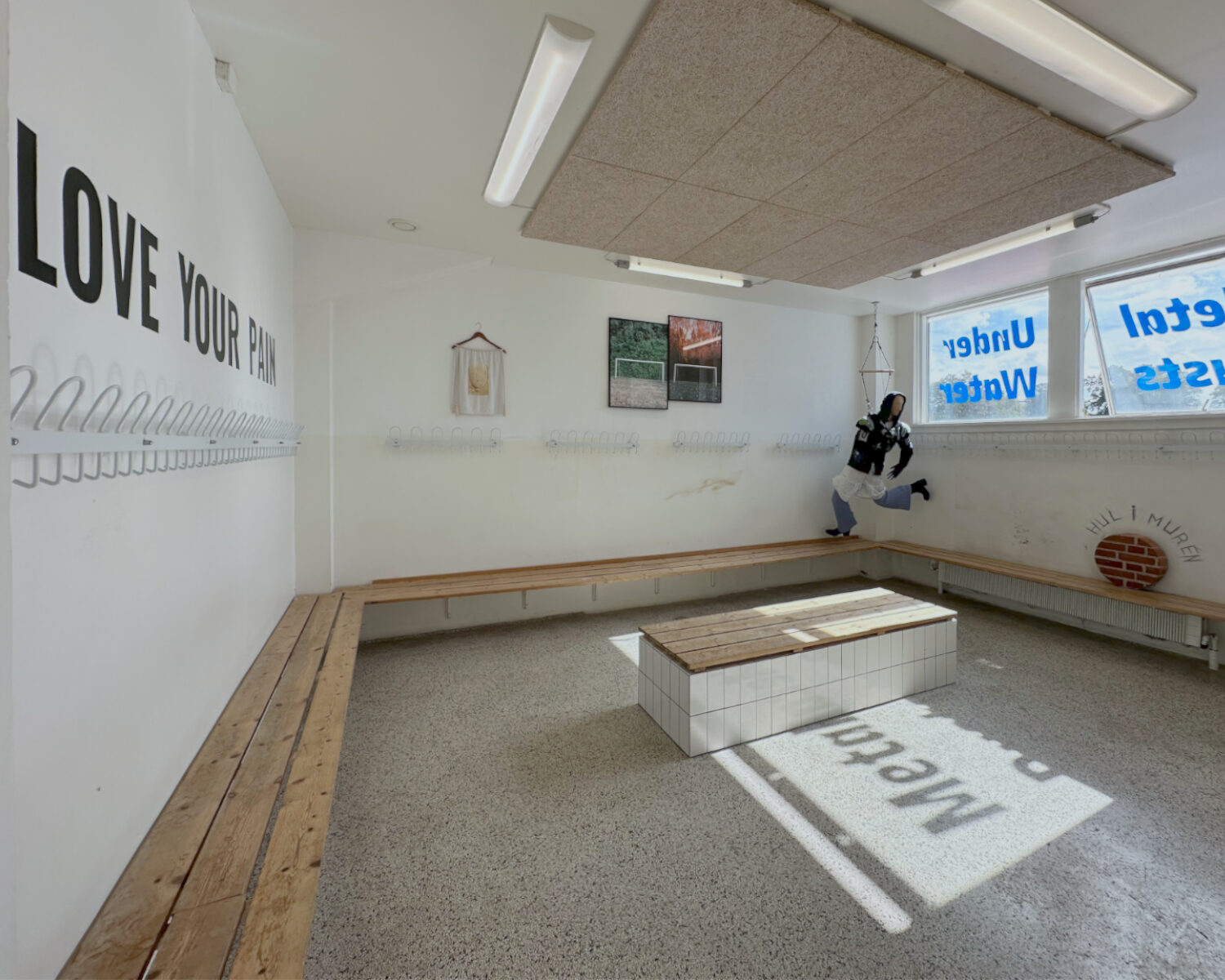
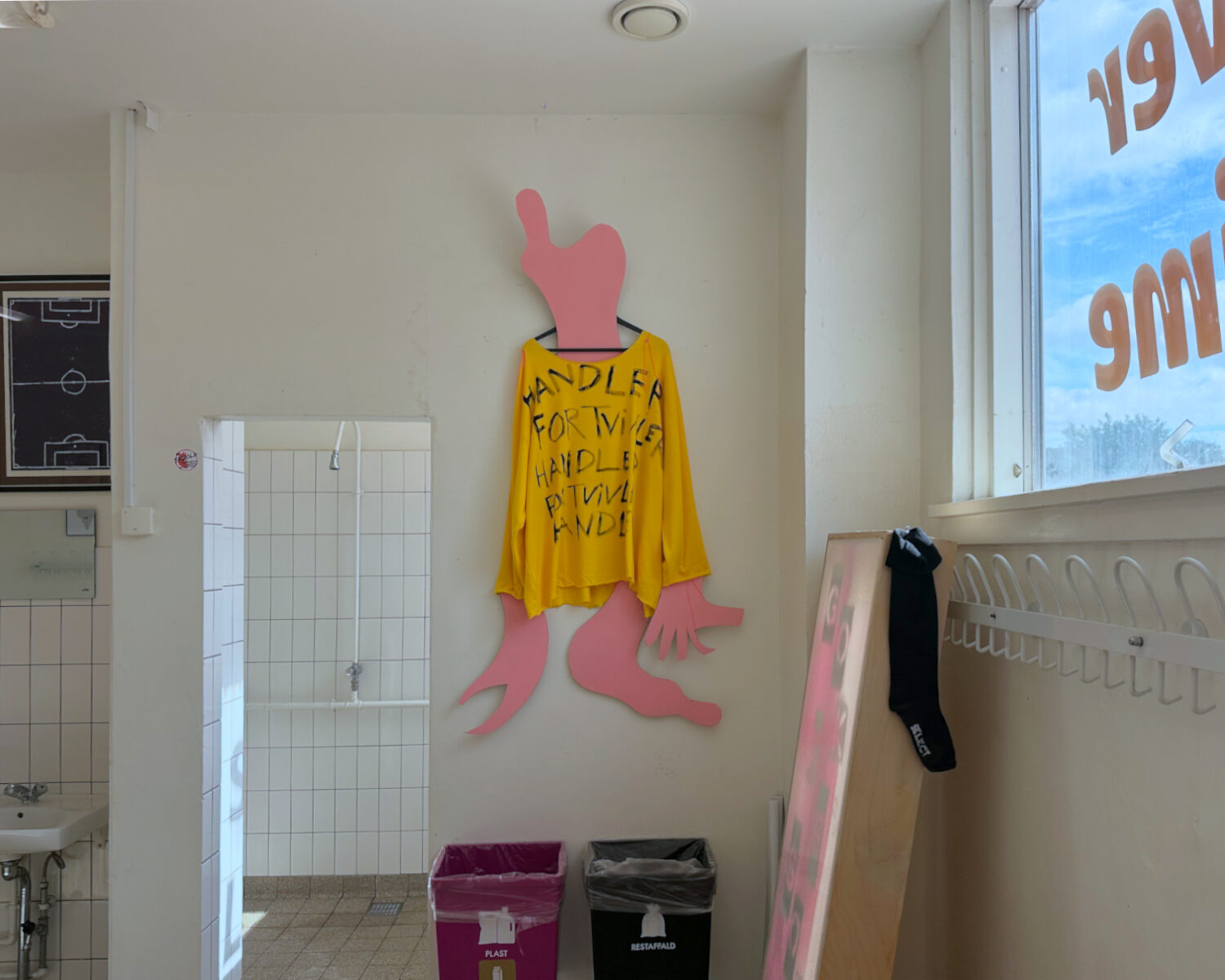
The changing room is roughly 4 × 5 metres, with wooden benches lining its perimeter and creating a little island in the middle, which is surely the dominant feature of the room. Next to where I entered, the door to the toilet is located and beside it direct access to the showers. Here, the wall is lined with panel windows at a height that makes it impossible to see anything of the surroundings besides the blue sky and huge sticky letters forming slogans in each window panel. They read something like “Dust forms”, “over time” and in the shower the phrase “sweat leaves” is glued to the window panels. I suppose it is a residue from a previous exhibition, as I haven’t noticed any specific tag that would give me more information about the origin of these slogans.
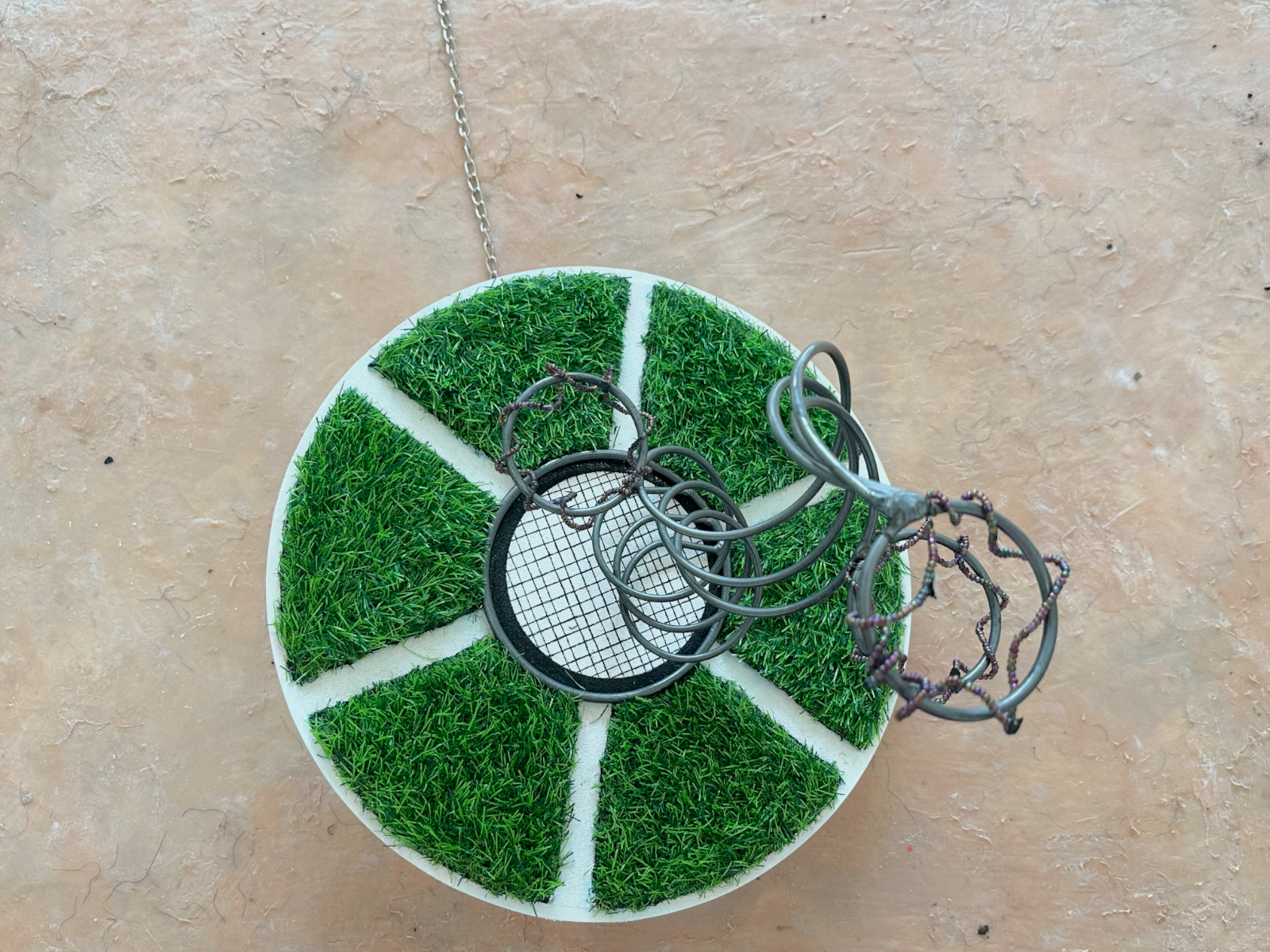
What caught my attention was a box, placed right next to the bench aisle in the middle. Its sides were tiled with the same white tiles as the bench. It had the same height, but what gave away its role in the exhibition were the little wooden legs in each corner, as well as ultimately the artwork positioned on the box. At first glance it reminded me of this spinning-top toy that I used to play with growing up, but the main difference was that this artwork had rather a half-sphere bottom and had no stick to make it spin with. It made me think about a rather fragile balance. Whether in art or on the football pitch – especially at this point, when I looked at the object from above and saw the fake grass, the line separating the two halves and the goal net in the middle – the work gave me the feeling that I was supposed to throw a ball and try to make it pass through all the hoops created by the metal wire, spiralling from the football net to a height of around 24 cm above the “football field”. Even though the object wouldn’t actually start spinning, I almost felt the thrill of scoring a goal (regardless of the fact that I am not sure I would actually be able to manoeuvre a ball into the goal). This particular artwork was made by Copenhagen artist Alida Lama and is titled Finten [Engl. the feint] (2026).
To also give you a glimpse of the changing room number 2, the name that personally struck me while reading the list of artists was Mette Kit Jensen, a Danish artist. In her practice she is focused on the exploration of flaneurism and the perception and exploration of urban spaces and our bodies within them. I remember her because I stumbled upon one of her projects called Tipsy walk Norrebro, back when I was trying to find a fine arts internship in Copenhagen. She caught my eye because of this particular workshop she organised, which was mainly focused on creating custom walk paths within the urban environment with glasses with differently coloured drinks and print-out maps. You would pick a drink of your choice, get a printed map of the neighbourhood and after finishing the drink make an imprint of the wet edges of the glass. The stain marks the path you will have to take. Climb over fences, sneak into strangers’ gardens, and take a walk, but a little differently. Also, on Mette Kit Jensen’s website, you can read more about the workshop, and if you live in Copenhagen you can even print out the map she used and have this experience on your own, or with your friends.
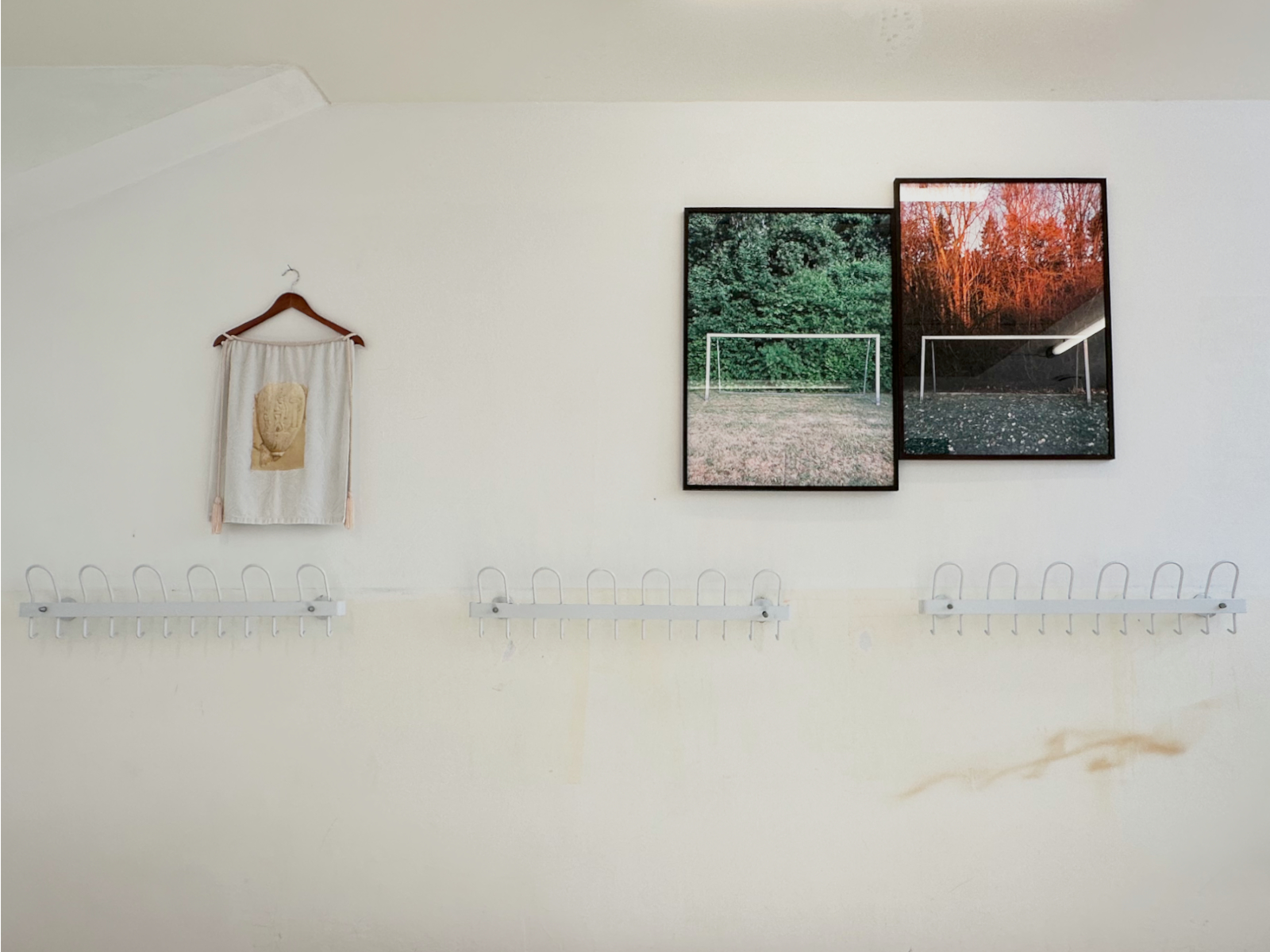
In the changing room number 2 Mette Kit Jensen has an artwork titled Nu, nu, nu, nu, ทน… (2026). It is a collage of objects, whose main aim is that of “holding” – she combines a mahogany clothes hanger, onto which a net curtain rope in baby-pink is tied and that at the same time is holding a white towel. There is a sewn rectangle from a T-shirt onto which a print of a Greek marble relief has been transferred. I am honestly blown away by the high quality of the print: it almost seems as if it was soaking into the towel. On the other hand, it feels sort of inappropriate in the setting of what is probably a men’s changing room. Like, the white towel, with the mahogany and pink curtain, gives me such a girly, sweet and soft feeling, especially as the towel has this texture of a flower on it. Like a little girl amidst the men. Feels so vulnerable, ironically enough so soft, as opposed to the solid feeling of the marble relief on which there are two men, one being almost twice as big as the other one, and the bigger one looking like he is practising football tricks naked with a ball on his hip. I have no idea what to make of it.
I can hear my footsteps resonating as I walk down the long hall lined with lockers towards the natural light coming from the open exit doors, and I have the same sensation as when I was leaving the last football match I attended. But I do have to admit, I like the way my head hurts now that I am walking away. For me, the context in which artworks are created and exhibited is just as important as the artworks themselves, provided the exhibition context allows for it.
I have only been to a football match about eight times in my life, and I had never visited a football changing room. I expected the smell of sweat, but that was one of the biggest surprises: it wasn’t there. Instead, I found eleven works by eleven artists in changing room number 2, and another eleven works by eleven artists in changing room number 3.
Funnily enough, the two changing rooms share a wall that both divides and connects them. If you cut through the walls of rooms 2 and 3 in a floor plan, would the dividing wall sit exactly in the middle? Would the whole layout resemble a football pitch? Perhaps I’m pushing the analogy a little too far. Still, the question remains: was this a friendly match, a cold-blooded league game, or just a regular training session? I guess you’ll have to decide for yourself.
One last thing: if you ever find yourself at Boldklubben Skjold looking for these changing rooms, don’t panic if you can’t get any further than the football pitch. Just head to the bar on the ground floor and ask around. People involved in football turn out to be just as friendly as anyone else you might bump into on the street – and they’ll show you both the pitch and the changing rooms.
is a human being and a student of MA in Architecture and BA in Fine Arts. Her writing is focused on themes of representation and labour in the arts and architecture, as she tries to critically position herself within the world. Currently, she is working on sculpture-objects and site-specific installations that examine the processes of self-soothing in art production.
Satellit 2: Of(f) Spaces
Ob Garage, Umkleidekabine oder Autohaus: Was ist ein Offspace, wie finanziert er sich und worin liegt seine Relevanz? Wie unterscheiden sich mögliche Entwürfe voneinander und wann wird aus einem Gegenentwurf selbst eine etablierte Struktur? Satellit 2 versammelt fünf Beiträge, die das Thema in unterschiedlichen Tönen und Textsorten fragmentarisch zu fassen versuchen – von Salzburg über Berlin und Kopenhagen bis nach Rom.
Die Satelliten des magazin53a
Die Satelliten sind die thematischen Schwerpunktausgaben des magazin53a, die mehrmals jährlich erscheinen und mehrere Beiträge zu einer übergeordneten Fragestellung versammeln. Sie positionieren künstlerische und kunstkritische Praxis im Kontext überregional relevanter Diskurse und zeigen zugleich, wie sich diese Auseinandersetzung ins Verhältnis zu lokalen Kontexten setzen lässt. Nach dem Schwerpunkt Porträt in Satellit 1 nimmt Satellit 2 den Offspace zum Ausgangspunkt.


Das könnte dich ebenfalls interessieren
Noch eine Ecke weiter
November 16, 2026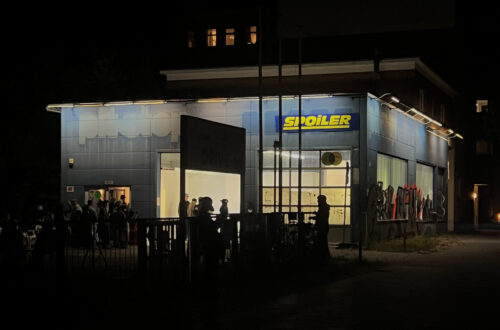
Kontrolliertes Schleudern. Built for Drifting im SPOILER Aktionsraum
November 16, 2026